





MusicRadar Verdict
This is (yet) another fine release from Cherry Audio, which continues to seek out old classics that still have plenty to offer and repackage them for the contemporary domain. It's a stylised instrument, but very in vogue with current production styles.
Reasons to buy
- +
Stunningly recreated model of the ESQ-1 from Ensoniq
- +
Replete with all of the original waveform content
- +
Extends the scope of the original instrument, with extensive modulation control, FX and loads more
- +
No more small-screen keyhole surgery – the interface is intuitive, superb and LARGE
- +
Officially licensed and endorsed
Reasons to avoid
- -
The late '80s sound might not entirely chime with you… but that’s a taste thing!
MusicRadar's got your back Our team of expert musicians and producers spends hours testing products to help you choose the best music-making gear for you. Find out more about how we test.
What is it?
By the time we reached the mid-'80s, the exclusive use of analogue circuitry in synthesizers was beginning to become a little bit… well… '70s! You couldn't ignore the beauty of analogue oscillators and filters, but the dominance of Yamaha’s FM/DX series of synths (better described as phase modulation synthesis) was having an enormous effect on commercial music and the retail market in general, offering crisp digital sounds at a far more affordable price tag.
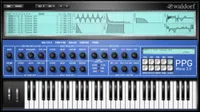
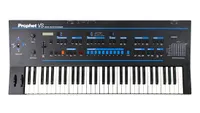
Several companies were exploring the hybrid route, combining more complex digital oscillators with the warmth and saturation of analogue filters. Despite many of them hovering below the musical radar, machines from this era are still held in high regard – the PPG Wave 2.2, Sequential Prophet VS, and another vintage classic to grab Cherry Audio’s attention: the Ensoniq ESQ-1.
The Ensoniq success
Ensoniq was founded in 1982, with its first entry to the market being in 1985 – and what an entrance it was! The Mirage was a sampling keyboard, but at an exceptionally attractive price of around $1,500. No longer did you have to sell your internal organs in order to afford a Fairlight or Synclavier!
The success of the Mirage was quickly followed by the release of the ESQ-1, a synthesizer reliant upon digital waveform generation and offering 32 different waveforms. Moreover, the ESQ-1 offered three oscillators which fed a classic Curtis-based low-pass filter, the theory being that the Curtis filter would lessen the harshness of the digital oscillators.
Ensoniq didn't need to worry on this front, because the range of available waveform content provided capacity to generate far more complex sounds than traditional subtractive machines, although the faithful saws and squares remained available, alongside more complex offerings.
Not only does Cherry’s ESQ-1 provide all of the original waveform content, alongside the original factory patches, but the instrument is also the first to be produced collaboratively and receive full endorsement from Creative Technology Ltd, which owns the rights to Ensoniq’s intellectual property.

Performance
If you are familiar with Cherry Audio’s work, you will have a pretty good idea of what to expect.
First and foremost, the graphics are extraordinarily beautiful. The panel is laden with buttons, '80s-style turquoise displays, faders and a sense of three-dimensional indentation which looks stunning on your computer screen. We have always really appreciated the fact that Cherry engineers a standalone version, and this invites you to blow the instrument up to the full size of your screen and just enjoy the interface, which adapts at every stage as you click. For anyone working on a smaller screen, such as a laptop, the Focus mode blows up an area of the GI for more detailed work, while also offering access to move around in this zoomed state.
Upon initial loading, the three oscillators present themselves with waveform displays. This can also be recalled by pressing the ‘play’ button, but the fun really starts when you dive into the oscillator level. On the far right of the panel, you can see the organisation of the signal flow, with three buttons that provide instant access to each oscillator section. Upon entering the oscillator layer, you can perform basic operations, such as waveform selection or implementing modulatory signals. The signal flow is presented from left to right, and while the filter is shared by all three oscillators, it's useful to have access here, along with Envelope 4, which handles amplitude duties. On the topic of which, the envelope functionality extends beyond the basic ADSR remit, providing far more complex proportions, along with a beautiful graphic to both indicate what's happening and allow a click-and-adjust approach, instead of using faders. ESQ-1 is equipped with four multi-stage envelopes, alongside three LFOs.
The modulation matrix is comprehensive too, and like other Cherry Audio designs, makes light work of the functionality. The four slots of the matrix can generate modulations from 41 sources and 85 destinations. Panel controls can also be quickly assigned to MIDI CC, and there is now the option of MPE control too, should you have an appropriate controller to use alongside the plugin.

Sounds of the '80s
Mid-to-late '80s synths are capable of some fascinating sounds, which are designed to mimic acoustic instruments. While some of these have an arguable date stamp, they are also quite endearing in nature.
One of the best places to revisit these sounds is the original factory preset list, included with the instrument. Alongside the usual '80s bright and cheery sounds, such as bells and digital choirs, many of the percussive tones, pianos, pads and organs are really superb and quite unique.
We have to be honest, it's been a while since we had our hands on an original ESQ-1, but the reminiscence level is high, as is the quality of the sounds. We have a feeling that the original machines shipped with a bit of background noise, and being redeveloped in software, Cherry’s modelling keeps the output clean and production-ready.
Cherry has also included its usual impressive collection of preset patches, which extends the original remit considerably, through use of its superb internal effects processing, with welcome additions, such as the arpeggiator and sequencer.
Stripping sounds back to their constituent components always offers an interesting perspective, as you start to see some of the complexities and inner workings of the signal flow. Even a single oscillator with a degree of modulation can entertain, but summing signals together allows the creation of some very detailed and weighty sounds.
The modelling of the filter is one of our favourite elements here. You can switch between 12/24dB low-pass modes, with the precision offered by the cutoff feeling very musical and exacting. With resonance applied, you don't get the harshness or low-end drop, which is so often attributed to filters of this era, making this a beautifully modelled and very musical component. You can also switch to either high-pass or band-pass modes, which sound superb when used on some of the weightier initial waveforms, provided by the oscillator level.
If we add into the equation the voice architecture, which has been extended to offer stereo layering and up to 32-voice polyphony, it's an exceptionally capable unit, but it does sound overtly different to many of Cherry’s other products. This has to be a good thing, right? We want different-sounding synths, and the ESQ-1 certainly packs character!

Verdict
The widespread use of the ESQ-1 was by no means as all-encompassing as other vintage classics from the early '80s. Artists such as Jean-Michel Jarre, Prince, John Carpenter and even Swedish rockstars Roxette were all ESQ-1 users, but in line with other products from this era, it became a lesser-used instrument, thanks to the dominance of sampling at this time.
This means that it's definitely worth a revisit, because beneath the beautiful '80s graphics lies a musical engine which Cherry has re-engineered, giving it life way beyond the original. Apart from the production-ready status of the initial sonic elements, the backend FX finery adds a further layer of gloss, making the ESQ-1 usable and entertaining. It’s just a little bit off the beaten track, and who doesn't want a slightly different sound to rubber-stamp their productions?
Hands-on demos
Cherry Audio

Alternatives
Specifications

Price |
$69 |
Key features |
3 Oscillators per voice Low-pass filter, modelled on the renowned Curtis CEM3379 chip 4 x multi-stage envelopes 3 x LFOs Assignable modulation matrix 32 note polyphony 20 x Studio quality FX |
System requirements |
MacOSX and WindowsPC : AU, VST/3, AAX & Standalone formats |
Contact |
