





MusicRadar Verdict
The EXO 28 is a big bulky monitor ideal for medium to large rooms. If you have the space, it’s an excellent option that delivers both power and finesse.
Reasons to buy
- +
New LF and HF drivers.
- +
Wide new tweeter waveguide.
- +
Digital input.
- +
Ethernet connectivity.
- +
DSP-based adjustments.
Reasons to avoid
- -
Rear menu based settings a bit fiddly.
MusicRadar's got your back Our team of expert musicians and producers spends hours testing products to help you choose the best music-making gear for you. Find out more about how we test.
What is it?
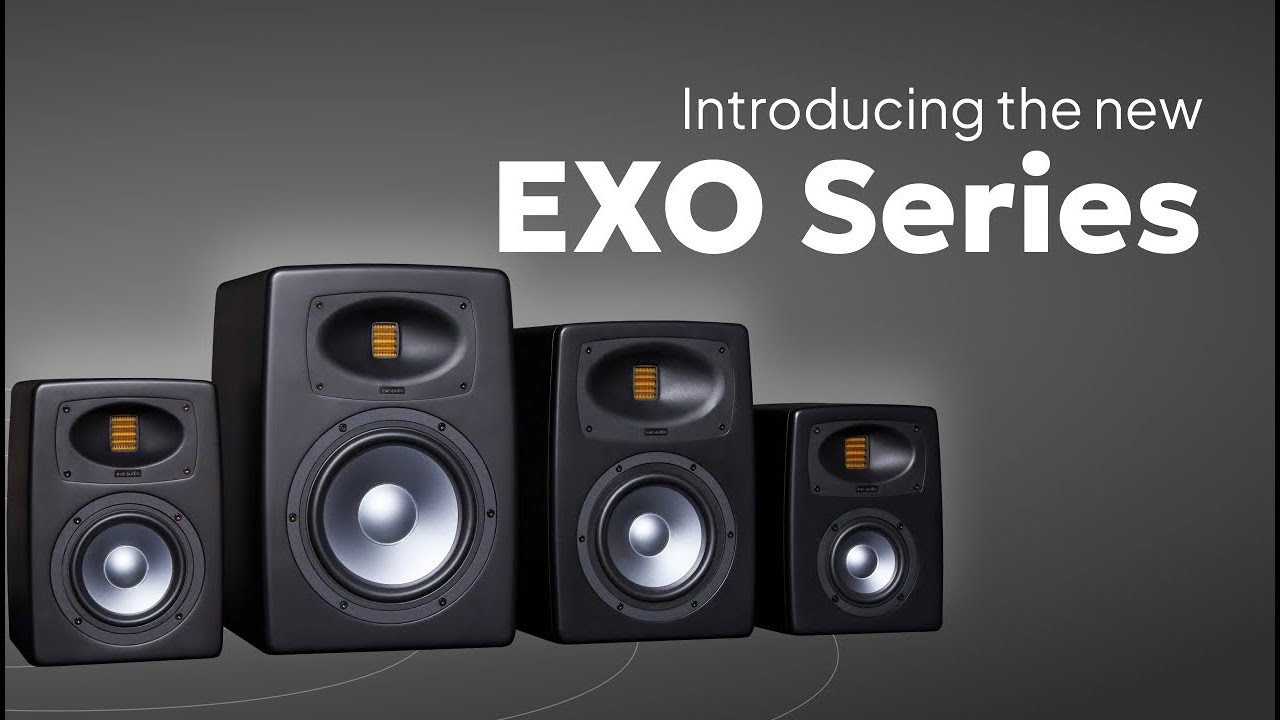
Eve Audio produce a number of AMT (air motion transformer) tweeter-equipped studio monitors, including the highly regarded SC2070. Its latest range, EXO, is designed for both stereo and multi-channel applications and up for review we have the EXO 28, which is the largest model.
EXO 28 is a 2-way ported monitor with a rear-positioned slotted port and onboard Class D amplification. High frequencies are handled by Eve’s new Precision AirMotion (PAMT) tweeter; meanwhile, the LF duties are handled by a newly designed 8” LF unit. This features a lightweight aluminium-coated diaphragm with a resonance-damped dust cap.
As you might expect from an 8” design, the EXO 28 is a pretty bulky and heavy (11.6kg) monitor designed for medium and large control rooms. The cabinet is reasonably plain and features low-diffraction rounded edges; meanwhile, the underside has M6 mounting points for bracket mounting. The PAMT tweeter sits inside a new advanced waveguide. This is larger and noticeably smoother than the waveguide we tested on the EXO 24. The waveguide also incorporates the backlit logo power indicator, but beyond this there are no further front baffle controls.
Onboard DSP-based settings are all made on the back panel using the push-button encoder and menu-driven mini OLED screen. By default, the knob sets the volume, meanwhile menu options include EQ, input connector choice, operating level and input delay (up to 18ms), as well as further system settings. The EXO 28 includes unbalanced (RCA) and balanced (XLR) analogue inputs, though no ¼” jack, as well as S/PDIF digital input and output (thru) on a pair of RCA connectors.

Performance
The EXO 28 is equipped with an Ethernet input and a control software package used for direct communication and setup purposes. As mentioned, settings can also be made via the rear-mounted mini OLED screen. This menu-driven system is very easy to navigate, although a bit fiddly at times. It also requires you to have visible access to the back of the monitor so you can see what the display says. Even so, the options are pretty good and include 4 ‘Smart’ EQ bands. The parameters are similar to the smaller EXO 24, in particular the high shelf (+5/-3dB at 5kHz) and bell-shaped mid band (+3/-5dB at 3.5kHz). However, the EXO 28 gets slightly different low- and mid-frequency options with desk correction at 400Hz (+3/-5dB) and low-cut filtering at 5 to 50Hz. The low shelf is at 300Hz (0 to +3dB).


Larger nearfield monitors typically produce a more satisfying soundstage than smaller designs, and the EXO 28 doesn’t disappoint. The overall delivery is well balanced and the imaging is broad and engaging. There’s plenty of low end, but it’s not artificially punchy like smaller designs; meanwhile, the highs are clear without being fatiguing. Out of the box we didn't feel the need to tweak the room correction EQ that much, and the modest changes necessary sound very musical. These speakers can also shift some air – the quoted half space max SPL is 128dB (120dB free field).
One key aspect of the EXO 28 design is the large tweeter waveguide. This delivers a broad listening sweet spot, particularly in the horizontal plane. Finally, for the very low frequencies, the quoted specification is -3dB at 37Hz, which is pretty decent. In testing we found the frequency was reasonably flat to around 55Hz, and then there’s a gradual tail off to about 35Hz.
Verdict
The EXO 28 certainly suits larger control rooms, but if you can accommodate their physical size, they would work perfectly well in smaller spaces too. Meanwhile for multichannel setups you could easily combine them with smaller models from the Exo range.

Hands-on demos
EVE Audio
Alternatives
Specifications
Price |
£1,399 per pair |
Configuration |
2-way rear ported |
Free field frequency range (-3dB) |
37Hz to 24kHz |
Drivers |
LF 8” coated aluminium, HF air motion transformer (AMT) |
Inputs |
XLR, RCA, S/PDIF digital in/out, LAN |
Output power |
140W (LF) 140W (HF) |
High shelf EQ |
5kHz +3/-5dB in 0.5dB steps |
Mid bell EQ |
3.5kHz +3/-5dB in 0.5dB steps |
Desk correction filter |
400Hz +3/-5dB in 0.5dB steps |
Low shelf or filter |
300Hz 0 to +3dB, low cut filter 24dB/oct at 5-50Hz in 5Hz steps |
Delay |
Adjustable per speaker up to 18ms |
Display |
Rear mounted OLED with encoder knob |
Max SPL |
126dB (half space) |
Crossover |
2.2kHz |
Mounting |
50.8 x 107.9mm M6 mounting points |
Dimensions |
276(w) x 401(h) x 331(d) mm |
Weight |
11.6kg |
Contact |
