





MusicRadar Verdict
Arturia's upgraded MiniFreak builds on the original without upsetting the winning balance between ease-of-use and creative potential. There's no real 'must-have' new features, but the 49 is an all-round improvement on a great synth.
Reasons to buy
- +
Improved and expanded keybed makes for an immediately more playable synth.
- +
Expanded oscillator controls make for an all-round better sound design experience.
- +
Audio-rate filter modulation is a fantastic addition to the toolkit.
- +
Touch matrix works nicely, particularly for modulation assignments and preset browsing.
Reasons to avoid
- -
There are no 'game changer' additions that would make this a must-have upgrade for owners of the original.
MusicRadar's got your back Our team of expert musicians and producers spends hours testing products to help you choose the best music-making gear for you. Find out more about how we test.
What is it?
Arturia’s MiniFreak 49 is a new expanded model of one of my favourite hardware synthesizers of recent years. Arriving in late 2022, the original MiniFreak was a 6-voice hybrid polysynth that combined two digital oscillator engines with an analogue multimode filter, VCA and flexible, three-slot digital effects engine.
Despite the inclusion of that analogue filter, what made MiniFreak so interesting was the ways it leant into the creative capabilities of its digital oscillators. This was no simple virtual analogue (although it was capable of being used as such) but rather a synth that, like its MicroFreak precursor, revelled in the weirder and more experimental ends of digital synthesis more commonly found in the Eurorack realm.
That modular influence was made explicit by the synth’s inclusion of oscillator modes developed in collaboration with Noise Engineering, as well as several based on open source code from Mutable Instruments. Between them, the oscillator modes were capable of approaches including two-oscillator FM, waveshaping and stacked super waves, as well as more esoteric approaches to sound generation, such as noise, speech, formant and Karplus–strong synthesis.
None of those oscillator modes were necessarily groundbreaking in and of themselves, but what made the MiniFreak interesting was the way in which it placed these varied and unusual sound sources within such an approachable instrument. Each oscillator mode shared the same three-parameter layout, and while that meant that the level of control could feel a little restricted in some cases, it made for a synth that was extremely easy to morph and manipulate.
The same could be said for the rest of the synth’s design, which blended elements aimed at experimentation – the loopable Cycling LFO and a flexible mod matrix – with an approachable design unlikely to be off-putting to most synthesists.


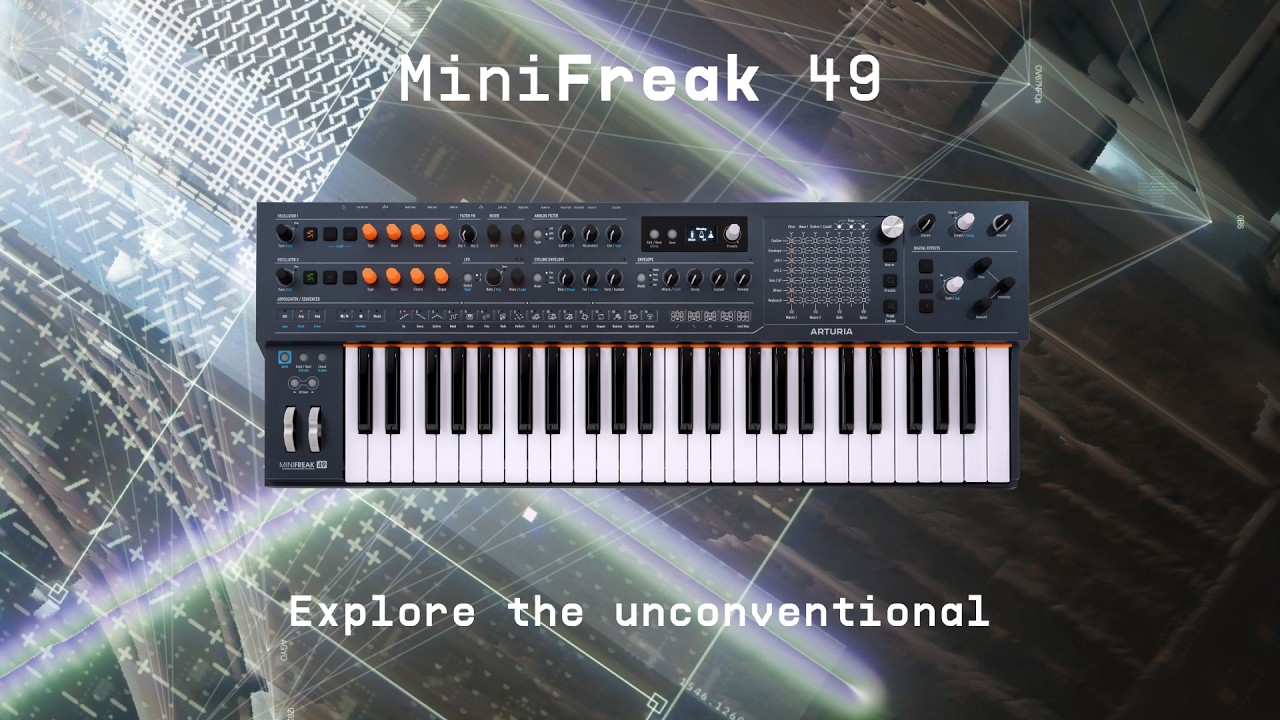
MiniFreak 49 is, essentially, that same synthesis engine in a bigger box with an improved control surface. While the original had 37 ‘slim’ keys, the 49 has full-sized, semi-weighted keys and adds an additional octave.
The synth also has an expanded range of front panel controls, most notably adding full control sections for both oscillator engines as well as a new ‘multidimensional’ touch matrix used for modulation routing, preset browsing and macro control.
It’s slightly inaccurate to describe the underlying synth engine as being exactly the same as the original MiniFreak though. For one thing, that engine has been substantially upgraded through firmware updates since the original hit the market, adding features including wavetable, sample and granular synthesis modes as well as a vocoder.
What’s more, the MiniFreak 49 adds some small but notable features of its own too, in the form of a new stereo spread parameter and a control for introducing audio-rate filter modulation.
Pricing
Launch price: £699 / €799
Performance
The upgraded keyboard is the most immediately obvious improvement introduced by the MiniFreak 49. With its mixture of influences from weirdo digital devices and classic polysynths, the MiniFreak is a great synth designing pads and ambient textures, and its compact keybed has always felt like a slightly restrictive way of playing such expansive sounds.
Although a single additional octave is a fairly minor upgrade on paper, combined with the jump from slim to full-sized keys it makes the playing experience feel less like a compact synth and more like a proper keyboard. The design also introduces proper pitch and mod wheels, instead of the touchstrips found on the original, and although aftertouch is still monophonic, it feels more expressive simply due to the larger, nicer keybed.
When it comes to interacting with the synth, however, the most exciting improvement is the addition of full knob-per-function control over the MiniFreak’s dual oscillator engines. The original version required users to select engine 1 or 2 using a button before adjusting each engine’s parameters. To be honest, I never found this all that limiting at the time, but within minutes of first switching on the MiniFreak 49 it quickly became clear how much more interesting and expressive it can be to manipulate both engines simultaneously.


This is particularly true when using engine 2 to process or interact with the audio of engine 1, as when using the FM/AM synthesis mode or processing sounds through the Multi, Surgeon and Comb filter modes.
Along with a full suite of controls for each engine, in another nice touch, the 49 also adds quick access buttons for some of the most useful oscillator functions, such as the Basic Waves mode – handy for quickly thickening up sounds with a simple sub oscillator – and the Wavetable and Sample engines. The controls for these can also be used to quickly load source sounds from the onboard library.
Improved interaction
The new XYZ ‘multidimensional’ matrix is a nice addition too. This can perform a few different functions. The first is as a means to touch and assign modulation routings, which is very easy to use and makes for a fantastic way to avoid menu diving.
The matrix can also be used for browsing presets, with the grid used to select sounds and the accompanying rotary selecting different banks. Again, this works great and really speeds up the process of navigating through the onboard sounds.
The final ‘Freak Control’ mode is actually a collection of four different control layouts. The first of these replicates the two Macro touchstrips and the sequencer’s Gate and Spice parameters, as found on the original. The remaining three modes use the XY pad in different layouts to offer multidirectional control over pre-mapped envelope, filter and effect parameters for each patch.
These modes respond not only to where you touch the matrix, but the width of your point of contact (hence the ‘multidimensional’ tag). This works, although, perhaps because I’ve been spoiled by the lovely ‘morphee’ controller found on Arturia’s high-end PolyBrute synth, it doesn’t feel quite as responsive or expressive as I’d hoped when reading the specs.
In another, slightly hidden feature, the pad is also used along with the sequencer to input steps for the customisable User LFO mode, which makes the process of inputting custom curves a lot easier.
Get your Freak on
While most of these new features merely offer new ways to interact with the existing synth engine, there are two small but powerful additions for the MiniFreak 49 that open up new sound design capabilities.
The first of these is a stereo control placed on the output. Increasing this will spread the synth’s six individual voices out across the stereo field, with a few different modes on offer to control the manner in which they're distributed. With its capable stereo effect section, creating ‘wide’ sounds with the MiniFreak was never a huge problem in the first place, but this new control adds a nice touch of spatial depth nonetheless.
By far the best new feature, however, is the addition of a filter modulation control in the synth’s new mixer section. This allows users to apply audio rate modulation of the filter cutoff from either one of the two oscillator engines, by turning the dial to the left or the right.


This is a really fantastic addition to the synth’s sound design toolkit, capable of adding grit, movement and outright weirdness depending on how it’s applied. In all honesty I always felt like the analogue elements of the original MiniFreak were a little tokenistic – the analogue filter and VCA were a nice concession to offsetting the overtly ‘digital’ feel of the design, but did they really make the sound characteristics that different from the all-digital MiniFreak V version?
Filter modulation changes my opinion on this. With resonance cranked and audio-rate modulation applied, there’s a level of edge and grit available that makes you glad of that proper analogue circuitry. It shines an additional light on the benefits of those additional oscillator controls too. With filter modulation engaged and one of MiniFreak’s ‘weirder’ oscillator modes selected (Harm, Lick and Particles work great) its a real joy to get hands on with the Timbre, Shape, Wave and Cutoff dials and play with the way filters and oscillators interact.
Verdict
The MiniFreak 49 is undoubtedly the best version of Arturia’s hybrid ‘Freak engine we’ve seen so far. The improved playing surface, expanded control layout and added filter capabilities make this an incredibly pleasurable synth to design and play sounds with. The original MiniFreak struck a great balance between creative possibilities and ease of use. This latest version manages to refine both of those sides of its personality, adding a little extra sound design depth and a slicker workflow.
That said, there’s an argument to be made that, for all that it gets right, in some areas the MiniFreak 49 is a little bit of a missed opportunity. While its improvements are nice, there’s nothing here that quite makes this a ‘must have’ upgrade for owners of the original. I really love the filter modulation on offer, but is it really worth dropping an extra few hundred dollars/pounds for?
There are a few obvious additions that Arturia could have added that would push the existing MiniFreak engine to that next level: increased polyphony being an obvious one, poly aftertouch another. I’d love to see an expanded version with an additional oscillator or engine layer too.
This would, admittedly, turn the 49 into a whole different instrument at a more ‘pro’ price point. Perhaps I should stop wishful thinking and be thankful for what I have? After all, one of my favourite synths just got a little bit better. Who could complain about that?
Hands-on demos
Arturia
Alternatives

Specifications
Price |
€799 |
Key features |
6-voice polyphony 49-note full-size semi-weighted keybed with velocity and aftertouch Aluminum pitch and modulation wheels 2 digital sound engines with 30+ oscillator modes: > Arturia: Particles, Lick, Frozen, Raster, Skan, Hit Grains, Cloud Grains, Sample, Wavetable, Noise, Superwave, Harmo, KarplusStrong, BasicWaves, AudioIn, MultiFilter, SurgeonFilter, CombFilter, PhaseFilter, Destroy and Fm/Am > Mutable Instruments: V.Analog, Waveshaper, Two Op. FM, Formant, Chords, Speech and Modal > Noise Engineering: SawX, Harm and Bass Engine 2 can process Engine 1; Audio In can be routed through the voice architecture Polyphonic analog state-variable filters and VCAs, with audio-rate Filter FM from either engine 1 envelope per voice 1 cycling envelope per voice 2 LFOs per voice with user-customizable shapes XYZ touch matrix for visual feedback, modulation assignment, preset browsing and Freak Control Freak Control with Macros, Gate and Spice, plus bipolar and vector layouts Draw custom LFO shapes directly on the XYZ touch matrix Voice Panning with selectable stereo spread algorithms 3 digital FX slots with 13 algorithms available in each slot, incl. Self and Ext In Vocoder Larger OLED display 3 direct engine-access buttons per oscillator Intuitive 64-step sequencer with 4 lanes of automated modulation Performance Arpeggiator controls including octave jumps, ratchets, repeats and Spice & Dice 256 MB of sample and wavetable memory 350 factory presets 162 user preset slots Compatibility with original MiniFreak presets MIDI In/Out/Thru and USB-C connectivity Sustain, audio in and clock in/out connectivity Stereo outputs |
Contact |
